Introduction
In order to load new containers onto a vessel at a port, it might be necessary to temporarily discharge containers from the vessel onto the quay and then load them back again. This operation is referred to as restow. Maersk pays fees to the terminal operator for each restow made. The amount of empty containers loaded on a vessel at a certain port might have dramatic effects on the empty restow cost incurred by Maersk at the upcoming ports on the vessel rotation. Therefore, PLP factors in the chances of empty restows while deciding the optimal amount of empty loadings from/to each port.
Page Access
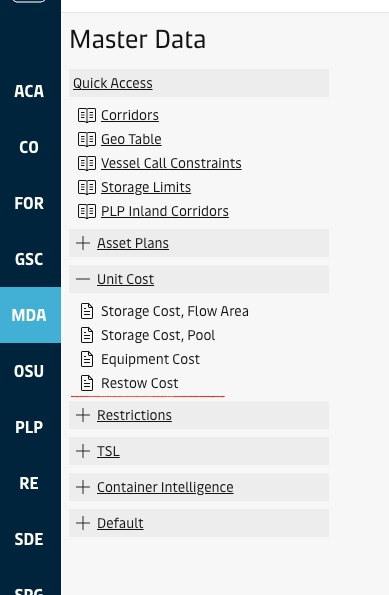
Stowage Rules can be accessed on "Restow Cost" section on the ROCK Master Data in Master Data module.
Overview
The user can take actions to manage stowage rules e.g. upload new/delete/promote/demote etc. using the standard ROCK master data module functions. Please refer to ROCK Master Data page to view details. Below descriptions aim to explain the content of the file.
Vessel Utilization Rule
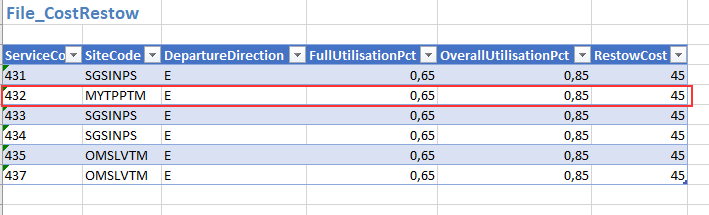
At the time of writing, the only stowage-related rule PLP considers is in relation to vessel utilization. Empty containers are typically loaded on top of full containers, if the vessel total utilization (full+empty containers) is above a certain threshold and the full utilization is above a certain threshold at the same time by the time the vessel arrives at a the port, PLP assumes that will lead to restowing empty containers at that specific port. While planning empty loadings from previous ports, PLP assigns a certain penalty to each empty container exceeding the limit. This penalty is actually the cost of restow for empty container at that port. The users should enter rule per service, direction and port code as seen below. The highlighted row below means; a vessel operating on service 432, which will call MYTPPTM port and depart at East direction, will cause empty restows during its stay at MYTPPTM causing 45$ restow cost per empty TEU, if the total utilization is above 85% and full utilization is above 65% at the same time, by the time the vessel calls this port. Note that PLP would not necessarily avoid violating these limits, though it would consider this additional cost as an input.
Attachments:
 image2018-9-27_9-25-29.png (image/png)
 image2018-9-26_14-23-2.png (image/png)
 image2018-9-26_14-27-6.png (image/png)
 image2018-9-26_13-50-52.png (image/png)
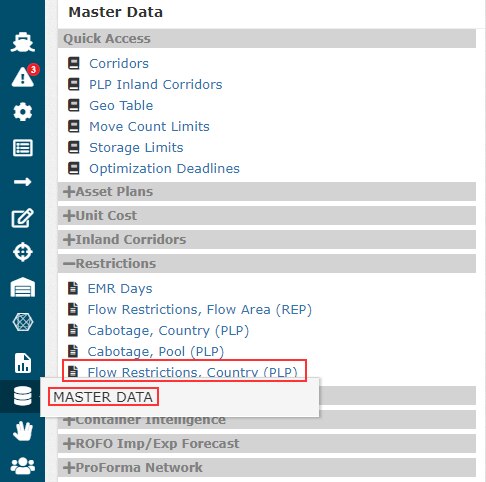 image2018-10-9_13-48-14.png (image/png)
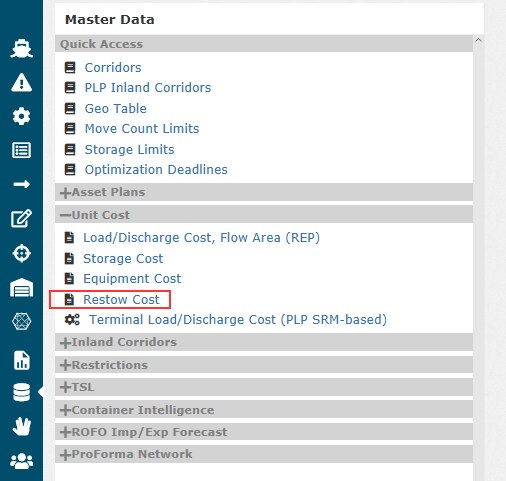 image2018-10-9_14-13-24.png (image/png)
 Screenshot 2025-09-04 at 10.03.09 AM.png (image/png)
