When creating or modifying OTTs, the OTT Management screen presents various constraints, which may be imposed by the system or driven by user restrictions. These soft limits are designed to guide the creation and modification of OTTs, ensuring that the proposed plans are valid.
Exceeding these limits triggers a warning from the system.
Remaining Capacity
Remaining capacity for a given OTT is calculated by subtracting the total fulls and planned empties from the allocation for each leg of the journey until the destination is reached. The system identifies and displays the lowest capacity of the schedule, on the page.
More information on capacity can be found here.
Remaining Moves
Remaining moves refer to the total crane moves available at a terminal. Moves limits are provided to ROCK by an external team, based on historical data.
Remaining moves is determined by taking the move limit and subtracting the currently planned empties for all OTTs that are either departing from or arriving at the same terminals, and are on the same vessel.

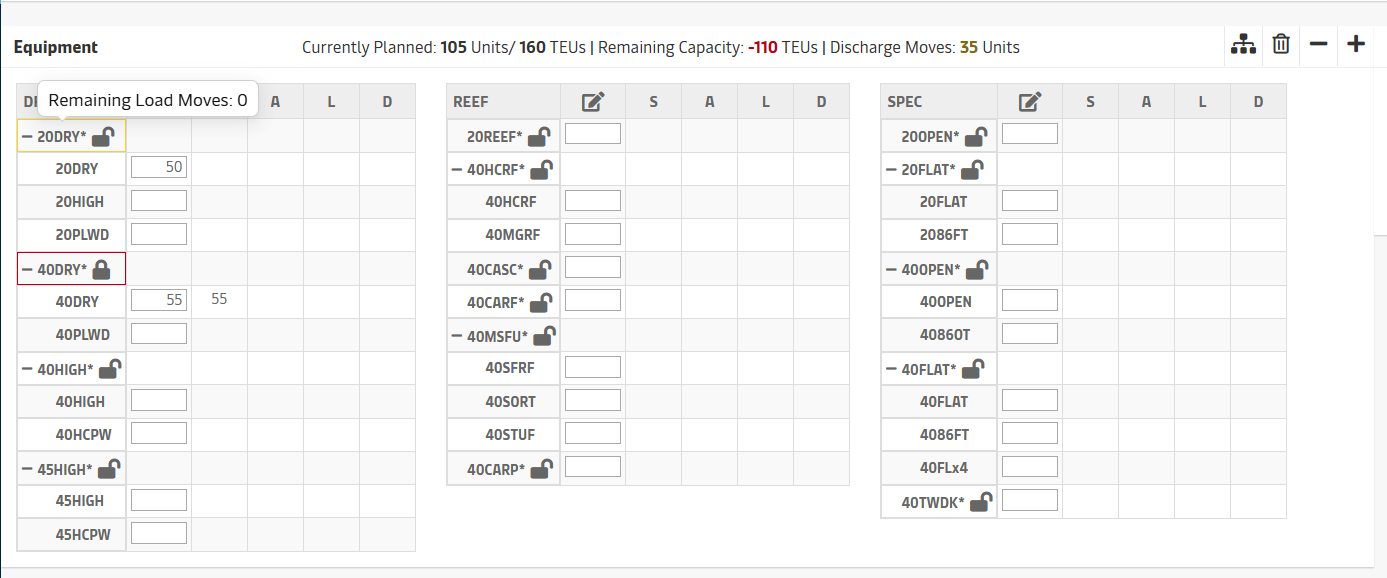
Remaining Equipment Group Moves
Remaining equipment group moves are dictated by user move limits added to the Vessel Call Constraints screen under master data. For each OTT, the calculations for each group are performed individually, based on the equipment's move limit minus the currently planned empties for all OTTs that are either departing from or arriving at the same terminals, and are on the same vessel.
Remaining Load moves is calculated as
Origin Move Limit - Planned origin moves
Remaining Discharge moves is calculated as
Destination Move Limit - Planned destination moves
Attachments:
 image-20250211-125424.png (image/png)
 image-20250211-125426.png (image/png)
 410996845-2fca4a71-ced0-466a-89c5-5eea1b6e8cbc-20250211-133342.png (image/png)
 image-20250211-133424.png (image/png)
