Introduction
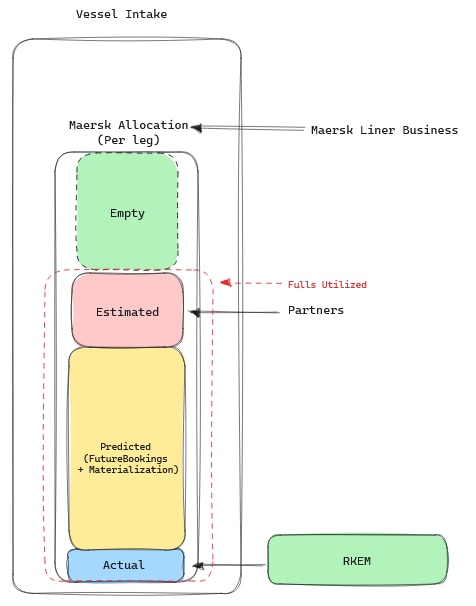
ROCK calculates empty capacity allocation based on data from Captura and "Capacity Inventory" systems.
Conceptual Approach
The Capacity, Allocation and Intake information per vessel call is based on the following data inputs:
Data | Source System | Description |
|---|---|---|
Vessel Allocation Intake | Captura | Total Vessel Intake allocation per call, in terms of TEU/MT |
Vessel Utilization per vessel and leg | Capacity Inventory | Active or projected bookings expected to be materialized |
Declared Cap Per Service Call | FlowPlanner | Declared Intake per service call in terms of TEU and MT. |
Average Laden Per Service Call | FlowPlanner | Average expected laden TEU and MT per service call, as a result of FlowPlanner optimization. |
For each vessel call, the Empty Capacity is deducted for TEU and Metric Tonnes (MT) by subtracting expected MLB Laden numbers from the MLB Allocation.
Business Rules
Empty TEU Capacity
Does TEU Cap From FlowPlanner Exist? (Yes/No) | Formula | Developer Notes |
|---|---|---|
Yes | FlowPlanner Cap - ISNULL(UTM forecast, FlowPlanner avg) | CapFpTEU = fp.DeclaredTEUCap - COALESCE(u.FinalLoadingFFE*2,fp.LadenTEU, 0) |
No | Unlimited | 999999 |
Metric tons
Does TEU Cap From FlowPlanner Exist? (Yes/No) | Formula | Developer Notes |
|---|---|---|
Yes | Unlimited | CapFpMT = fp.DeclaredMTCap - COALESCE(u.FinalLoadingTons,fp.LadenMT,0) |
No | Captura Intake |
Attachments:
 image2019-11-28_14-3-38.png (image/png)
 BusinessRulesCapacityModule.xlsx (application/vnd.openxmlformats-officedocument.spreadsheetml.sheet)
BusinessRulesCapacityModule.xlsx (application/vnd.openxmlformats-officedocument.spreadsheetml.sheet)
BusinessRulesCapacityModule.xlsx (application/vnd.openxmlformats-officedocument.spreadsheetml.sheet)
BusinessRulesCapacityModule.xlsx (application/vnd.openxmlformats-officedocument.spreadsheetml.sheet)
BusinessRulesCapacityModule.xlsx (application/vnd.openxmlformats-officedocument.spreadsheetml.sheet)
BusinessRulesCapacityModule.xlsx (application/vnd.openxmlformats-officedocument.spreadsheetml.sheet)
BusinessRulesCapacityModule.xlsx (application/vnd.openxmlformats-officedocument.spreadsheetml.sheet)
empty_allocation.png (image/png)
BusinessRulesCapacityModule.xlsx (application/vnd.openxmlformats-officedocument.spreadsheetml.sheet)
BusinessRulesCapacityModule.xlsx (application/vnd.openxmlformats-officedocument.spreadsheetml.sheet)
BusinessRulesCapacityModule.xlsx (application/vnd.openxmlformats-officedocument.spreadsheetml.sheet)
BusinessRulesCapacityModule.xlsx (application/vnd.openxmlformats-officedocument.spreadsheetml.sheet)
BusinessRulesCapacityModule.xlsx (application/vnd.openxmlformats-officedocument.spreadsheetml.sheet)
BusinessRulesCapacityModule.xlsx (application/vnd.openxmlformats-officedocument.spreadsheetml.sheet)
BusinessRulesCapacityModule.xlsx (application/vnd.openxmlformats-officedocument.spreadsheetml.sheet)
BusinessRulesCapacityModule.xlsx (application/vnd.openxmlformats-officedocument.spreadsheetml.sheet)
empty_allocation.png (image/png)
